Hey there, if you’ve ever been tasked with sourcing building materials—whether for a warehouse, office, or even a cold storage facility—you’ve probably come across rock wool sandwich panels. You might’ve also asked, “What’s the actual cost of these things, beyond just the sticker price?” As a rock wool sandwich panel supplier who’s been in this game for over a decade, I’ve talked to hundreds of builders, contractors, and even property owners who only look at the upfront cost and end up regretting it later. Let’s break this down straight—no jargon, no hidden agendas, just what you need to know before you pull the trigger. Rock Wool Sandwich Panel
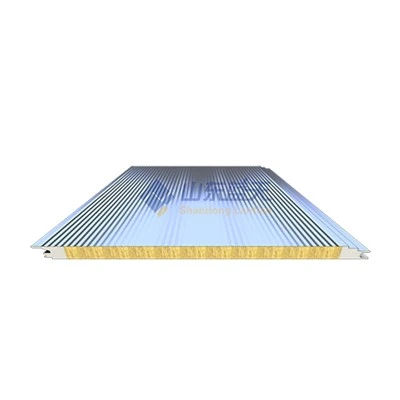
First off, let’s get one thing out of the way: there’s no one-size-fits-all price for rock wool panels. A lot of people see a $5 per square foot quote and think, “Great, that’s a steal,” only to realize later that panel is thin, uses low-grade rock wool, or has a flimsy metal skin that won’t last two years. I’ve seen that mistake more times than I can count. So, what actually drives the cost? Let’s start with the materials themselves. Rock wool isn’t just some random mineral— it’s made from basalt and slag, melted down, spun into fibers, then compressed into insulation. The quality of that rock wool matters a ton. Cheaper panels use lower-density rock wool (like 40kg/m³ instead of the standard 80-120kg/m³ for most commercial projects), which doesn’t insulate as well, doesn’t handle fire as effectively, and can even sag over time. High-density rock wool takes more energy and raw material to make, so that bumps up the cost a bit.
Then there’s the metal skin—usually galvanized steel, sometimes aluminum. The thickness of that skin is a big factor. A 0.4mm thick steel skin is way cheaper than 0.6mm, but it’ll rust faster, dent easier, and won’t provide as much structural support for walls or roofs. If you’re using panels for a warehouse that’s going to have heavy equipment moving around, a thin skin is just asking for dents that let moisture in, which leads to mold or panel degradation. Also, galvanization quality matters: hot-dipped galvanized (the good stuff) is more expensive than electro-galvanized, but it’s way more resistant to corrosion, especially in coastal areas or places with high humidity.
Size and customization play a role too. Standard panels are usually 10ft, 20ft, or 30ft long, with widths of 1m or 1.2m. If you need a custom length—say, 35ft for a high-ceilinged warehouse—we have to cut the metal and adjust the rock wool fit, which adds a little labor cost. Custom profiles, like corrugated vs. smooth skin, or edge details that fit specific building frameworks, also tweak the price. And if you need extra features—like a vapor barrier on the inside for cold storage, or a UV-resistant coating for outdoor roofs—that’s another line item.
Installation is another part of the “total cost” that people often forget. Sure, the panel itself might be $6 per sq ft, but if it’s hard to install because it’s too thin or the edges don’t align right, your labor costs could go up by $2-$3 per sq ft. On the flip side, high-quality panels with pre-cut edges, matching accessories (trim, fasteners, sealant), and lightweight designs make installation faster and cheaper. I’ve had customers who bought the cheap thin panels call us a month later saying their install crew was frustrated because they kept bending the metal, so they had to redo parts—costing them way more upfront than if they’d just spent a bit more on better panels.
Wait, let’s talk about fire ratings too, because that’s why a lot of people choose rock wool in the first place. Rock wool is non-combustible, which is a huge plus for commercial buildings, especially in areas with strict fire codes. But the fire rating (usually 1-hour, 2-hour, or 3-hour) depends on how the panel is assembled—thicker rock wool, better bonding between the core and the metal skin. A 1-hour fire-rated panel is more expensive than a non-rated one, but if your local code requires it, you can’t skip it. Cutting corners here can get you fined or, worse, lead to fire safety issues down the line.
Now, let’s get real with numbers, but remember these are 2024 averages, and they can shift based on material costs, shipping, and order volume. On the low end, basic, low-density rock wool panels (40kg/m³, 0.4mm steel skin, no extra features) will run you around $4.50-$6 per sq ft. These are okay for temporary structures or interior partitions where fire resistance isn’t a big concern, but I don’t recommend them for exterior walls or roofs. The middle range—80kg/m³ rock wool, 0.5mm hot-dipped galvanized steel, 1-hour fire rating, standard sizes—sits at $7-$10 per sq ft. This is the sweet spot for most warehouses, retail spaces, and office buildings. On the high end, custom panels with 100kg/m³ rock wool, 0.6mm steel, 2-hour fire rating, UV coating, or cold storage-specific features go for $11-$15 per sq ft. For large orders (like 10,000 sq ft or more), we can usually knock off 5-10% because we can get bulk material discounts and reduce production time per panel.
Wait, don’t sleep on shipping costs either. If you’re located far from our factory, we have to add freight to the price, which can be $0.50-$2 per sq ft depending on distance. Some suppliers will quote you a “base price” that doesn’t include shipping, so make sure you’re asking for the delivered cost, not just the FOB (free on board) price. I’ve seen customers get a shock when their final bill is 20% higher because they forgot to factor in shipping.
Another hidden cost: maintenance. Low-quality rock wool panels might need resealing every 3-5 years to keep moisture out, which adds up. High-quality panels can go 10+ years with minimal maintenance, just occasional cleaning. So, even if the upfront cost is a bit higher, you’re saving money long-term on upkeep.
Let me give you a quick example to put this in perspective. Suppose you’re building a 5,000 sq ft warehouse. If you go with the cheap low-density panels at $5 per sq ft (total $25k), you might have to replace parts in 3 years due to corrosion, and your energy bills will be higher because the insulation is poor. On the other hand, the middle-range panels at $8 per sq ft (total $40k) will last 15+ years, keep your energy costs down, and meet fire codes so you don’t have to worry about fines. That’s a no-brainer for most businesses.
Now, why do some suppliers have way lower prices? Sometimes they’re cutting corners on the rock wool—using recycled slag that’s not properly processed, or compressing it too thin so it loses insulation value. Or they’re using regular steel instead of galvanized, which will rust quickly. A few might even sell “rock wool” panels that are mostly fiberglass with a thin rock wool layer on the surface—so they get the fire rating label but don’t perform. That’s why it’s important to ask suppliers for product specs: density of the rock wool, thickness of the metal, fire rating, and material test reports. A reputable supplier (that’s me, by the way) won’t hesitate to share that stuff.
Also, let’s talk about sustainability, because that’s a big factor for a lot of builders now. Rock wool is made from 90% recycled materials (basalt from volcanic rock, slag from steel production), and it’s 100% recyclable at the end of its life. So even if the upfront cost is a little higher, you’re contributing to less waste, which might even qualify you for green building certifications that can lower your operating costs (like LEED credits). That’s a cost benefit people don’t always calculate.
Wait, what about installation mistakes? I’ve had customers call me after they bought cheap panels saying the edges didn’t line up, so they had to hire extra workers to fix it, which cost them more than the difference between the cheap and good panels. Properly made panels have precision-cut edges that fit together easily, so your installation crew can finish faster and with fewer mistakes. That’s a big one—don’t underestimate the value of a well-made product that’s easy to work with.
Let’s wrap this up. The “cost” of rock wool sandwich panels isn’t just the price tag on the box. It’s material quality, fire and corrosion resistance, installation ease, long-term maintenance, and even sustainability. If you’re trying to save a buck by going with the cheapest option, you’re probably going to end up spending more later. If you’re looking for a reliable panel that fits your project’s needs, I can help you figure out exactly what you need—no fluff, no hidden fees.
If you’re ready to talk through your project, whether it’s a small office or a large warehouse, reach out to me to chat through your requirements, get a customized quote, and make sure you’re getting a panel that’s worth every penny.
Clean Room Sandwich Panels References
- Rockwool International. (2023). Technical Handbook for Rock Wool Sandwich Panels.
- American Society for Testing and Materials (ASTM). (2022). Standard Specifications for Structural Sandwich Panels.
- National Fire Protection Association (NFPA). (2023). Fire Code Requirements for Building Insulation Materials.
- Steel Manufacturers Association. (2024). Galvanized Steel Performance Corrosion Resistance Data.
- U.S. Green Building Council (USGC). (2023). LEED Credit Guidelines for Sustainable Building Materials.
Shandong Lantian New Material Technology Co., Ltd.
Shandong Lantian New Material Technology Co., Ltd. is one of the most reliable manufacturers and suppliers of rock wool sandwich panel in China, featured by quality products and low price. Please rest assured to buy bulk rock wool sandwich panel for sale here from our factory. Contact us for pricelist and customized service.
Address: North End of Wanshida Road, Dianzi Town Industrial Park, Boxing County, Binzhou City, Shandong Province
E-mail: Lantian023@ltaaaaa.com
WebSite: https://www.ltpirpanels.com/
