If you’ve ever stood next to a magnetic polishing machine in action—watching small metal parts swirl inside a tank like they’re caught in some quiet, controlled storm—you might have wondered how that force actually works, and how strong it really is. As a magnetic polishing machine supplier who’s spent hundreds of hours testing these systems with job shops, aerospace teams, and automotive part makers, I can tell you: magnetic force strength isn’t a one-size-fits-all number. It’s a carefully calibrated variable, and getting it right is the difference between a part that comes out smooth, burr-free, and ready for assembly… and one that gets damaged, or doesn’t get polished at all. Magnetic Polishing Machine

Let’s start with the basics, because a lot of the confusion around this topic comes from mixing up “raw magnetic power” with “usable polishing force.” A magnetic polishing machine works by using rotating magnets placed under a non-magnetic tank (usually stainless steel or plastic) to create a moving magnetic field. Inside the tank, you load your parts and tiny, non-ferrous (or sometimes ferrous) polishing media—like ceramic beads, steel pins, or triangular aluminum shavings. The magnetic field grabs the media, dragging it in the same circular, swirling motion as the magnets below. That continuous, gentle, high-velocity friction is what buffs away burrs, removes oxidation, and gets parts to a mirror finish.
The force that drives that motion is measured in something called Gauss, a unit of magnetic flux density (how much magnetic field is present in a given area). But here’s the key: Gauss ratings are often listed on machine spec sheets, and suppliers will advertise numbers anywhere from 1,000 Gauss to 10,000 Gauss. That range isn’t random. A small, benchtop machine for polishing tiny jewelry components might top out at 2,000 Gauss, because too much force would crush the delicate parts or media. A large industrial machine for polishing engine cylinder heads, which are thick and have stubborn edge burrs, might use 8,000 to 10,000 Gauss.
But Gauss alone doesn’t tell you the whole story. I once had a customer last year who bought a machine from a competitor that advertised 12,000 Gauss, but their polishing results were terrible. The problem? The competitor built their machine with weak magnets spaced too far apart, so the magnetic field dropped off sharply as it passed through the tank wall. The usable force on the media and parts—what we call “working Gauss”—was barely 3,500, way lower than what they needed for their 10mm steel fasteners. That’s why when I walk customers through our machines, I don’t just talk about the peak Gauss; I explain the magnetic circuit design that keeps that force consistent across the entire tank floor, even 2 inches above the magnets.
Another factor that changes effective magnetic force is the size and material of the parts and media you’re working with. Ferrous media (like steel pins) are much more responsive to magnetic force than non-ferrous media, so you can run a lower Gauss setting and still get enough friction. If you’re polishing non-magnetic parts—like aluminum brackets or titanium surgical tools—you need to use ferrous media, and the magnetic force has to be strong enough to pull those media around the tank without slipping. Too weak, and the media just spins slowly, creating almost no polishing action. Too strong, and the media clumps together into a solid mass, which can scratch parts or leave uneven finishes.
I’ve seen this balance play out countless times. Last quarter, a medical device manufacturer reached out because their previous magnetic polisher was leaving tiny scratches on 316L stainless steel surgical clips. We tested their process: their machine was set to 7,000 Gauss, using 2mm steel media. The force was so strong that the media was colliding with the clips at high speed, leaving micro-abrasions. We adjusted the machine to a 5,200 Gauss setting, and swapped to 1.5mm media, which responded better to the lower force. The result was a scratch-free finish that met their ISO 13485 requirements, and they still get the burr removal they needed. That’s proof that magnetic force strength isn’t just a number—it’s a tool that needs to be calibrated to your specific part and media.
There’s also a common myth that “higher Gauss equals better polishing.” It’s true that more force can speed up polishing times for tough burrs, but it comes with tradeoffs. For example, a customer in the automotive industry wanted to polish 50mm crankshaft counterweights in half the time. They switched from our standard 6,000 Gauss setting to a custom 9,000 Gauss setting, expecting to cut their cycle time in half. Instead, the higher force caused the media to press too hard against the curved surfaces of the counterweights, leaving uneven polishing and even some edge rounding that made the parts unfit for their assembly line. We adjusted back to 6,500 Gauss, and they ended up with a more consistent finish in nearly the same time. It’s a perfect example of how overestimating magnetic force leads to bad results.
So, how do you know what magnetic force strength is right for your application? It starts with a few questions: What material are your parts made of? How thick are the parts, and what’s the hardness of their edges? What size and type of media do you use? For small, delicate non-ferrous parts (like jewelry, watch components, or electronic connectors), you’ll usually need 1,500 to 4,000 working Gauss. For medium-sized ferrous parts with moderate burrs (like fasteners, small pump components, or bicycle parts), 4,000 to 6,000 Gauss is ideal. For large, thick parts with heavy burrs (like engine parts, hydraulic components, or industrial metal tooling), you’ll need 6,000 to 10,000 Gauss.
But even that isn’t a hard rule. Magnetic field uniformity matters more than raw Gauss. If a machine has a weak spot in its magnetic circuit, parts and media in that area will move slower, leading to uneven polishing. That’s why all the machines our team builds go through a 10-point Gauss test across the entire tank floor before they leave our workshop. We test at different heights, too—because the force needed at the bottom of the tank (where media and parts sit) is different than the force needed a few inches up, where parts tumble freely.
I also can’t talk about magnetic force without mentioning wear and tear, because it’s not a static number. Over time, magnets can weaken (though high-quality rare-earth magnets, which we use in all our machines, only lose about 1% of their strength every 10 years, so that’s not a big issue for most customers). The bigger wear factor is the tank wall. As media rubs against the wall, it can thin over time, which changes how much magnetic force passes through. We recommend customers check their tank wall thickness annually—if it’s thinned by more than 0.5mm, you’ll need to adjust your Gauss setting, or replace the tank, to keep your force consistent.
Another common question I get is: can you adjust magnetic force strength on a magnetic polishing machine? The answer is yes, most modern industrial models have variable magnetic controls. Some machines let you adjust the rotation speed of the magnets, which effectively changes the force on the media—faster rotation means more centrifugal force, working with the magnetic pull to create more friction. Others let you adjust the gap between the magnets and the tank wall, which changes how much of the magnetic field is transmitted through the wall. That flexibility is key, because most customers’ needs change as their parts or processes evolve.
I recently worked with a aerospace shop that started out using their magnetic polisher only for titanium turbine blade roots, which needed a 7,500 Gauss setting. A year later, they added small aluminum hydraulic fittings to their workload, which only needed 3,000 Gauss. Because their machine had adjustable force controls, they didn’t have to buy a second machine—they just dialed the Gauss down for the new parts, saving them thousands of dollars. That’s the value of a machine that’s built with adjustable magnetic force, instead of a fixed high Gauss that works for only one application.
Let’s wrap this up with a real-world example of what happens when magnetic force is too low. A customer in the firearms industry came to us after struggling with a previous magnetic polisher that would take 8 hours to remove burrs from 9mm pistol slides. When we tested their machine, we found the working Gauss was only 2,800. That force was too weak to get the steel media moving fast enough, so the polishing action was just mild rubbing, not aggressive enough to cut through the edge burrs. We swapped their machine for one with a 5,500 Gauss adjustable setting, and their cycle time dropped to 2.5 hours—without any scratches or damage to the precision-machined slides. That’s the difference between understanding magnetic force strength and just picking a random number off a spec sheet.
At the end of the day, magnetic force strength is the backbone of any magnetic polishing machine, but it’s not the only factor that determines results. It’s how that force is distributed, adjustable, and calibrated to your specific parts, media, and finish requirements. If you’re in the market for a magnetic polishing machine, don’t get hung up on the highest Gauss number you see. Instead, ask about the magnetic circuit design, adjustability, and how the machine performs with parts like yours.
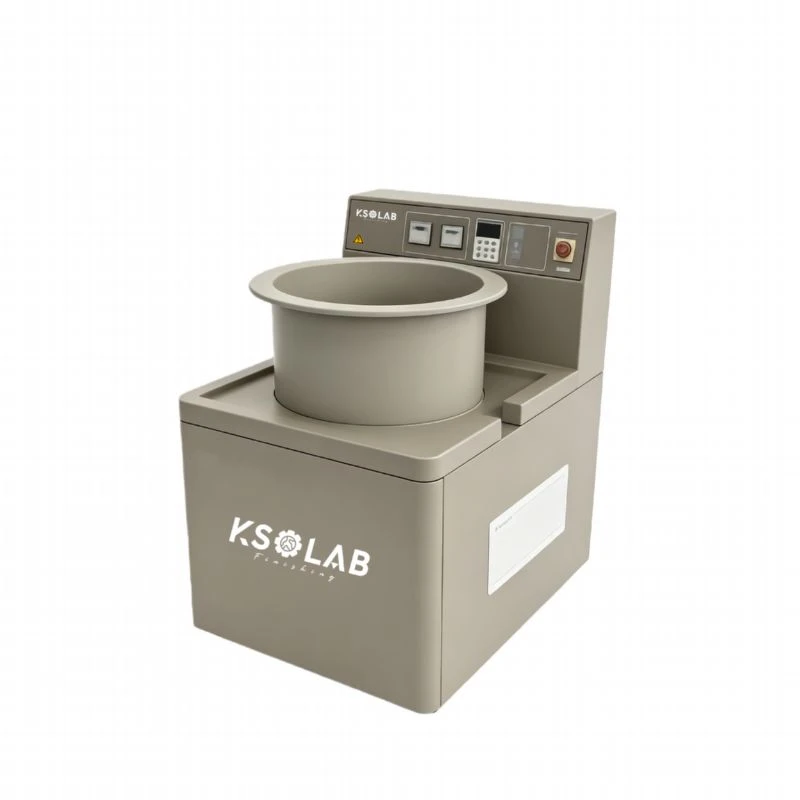
If you’re tired of machines that don’t deliver consistent, high-quality polishing, or you’re struggling to calibrate the right magnetic force for your application, reach out to our team to discuss your needs. We’ve worked with hundreds of customers across industries to build magnetic polishing systems that match their exact requirements, and we can help you find the right balance of force, speed, and finish for your parts.
Jewellery Polishing Machine References
- Dini, J. W., & Sabri, M. (2005). Magnetic Abrasive Finishing: A Review. Journal of Manufacturing Science and Engineering, 127(3), 705-713.
- Karnik, S. R., et al. (2008). Parametric Study of Magnetic Force in Magnetic Abrasive Finishing. International Journal of Machine Tools and Manufacture, 48(12-13), 1478-1485.
- Rare-Earth Magnet Industry Association. (2021). Magnetic Field Strength Measurement for Industrial Processing Equipment. Technical Report No. 021.
KS Lab Finishing Co., Ltd.
As one of the most professional magnetic polishing machine manufacturers in China, we also support customized service. We warmly welcome you to wholesale durable magnetic polishing machine made in China here from our factory. If you have any enquiry about pricelist, please feel free to email us.
Address: No.11-14, Yantian Shuibei Commercial Street, Fenggang Town,Dongguan,China
E-mail: sales@kslabfinishing.com
WebSite: https://www.kslabfinishing.net/
