Hey folks, it’s Jake here from your go-to ball bearing disc spring supplier—you know, the guys who actually get how much your machinery depends on those tiny, tough springs that hold everything together. Lately, I’ve been fielding so many questions from clients: “My spring is wearing out way too fast,” “It’s not delivering the consistent force I need for my assembly line,” “Why is my machine vibrating more since I swapped in those cheap disc springs?” If that sounds like you, you’re in the right place. Today, I’m breaking down exactly how to optimize the performance of a ball bearing disc spring—no stuffy engineering jargon, just real, actionable tips that I’ve tested in our warehouse and seen work for hundreds of our clients over the years. Ball Bearing Disc Spring
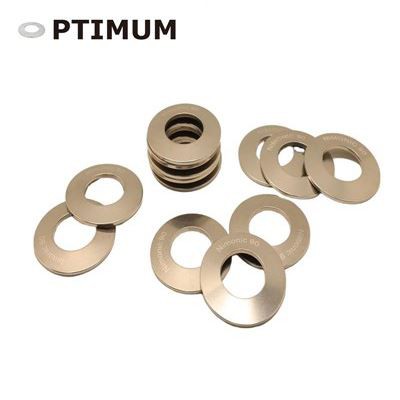
First off, let’s make sure we’re on the same page: a ball bearing disc spring isn’t just a regular washer with a curve. It’s a specialized, conical spring paired with ball bearings (usually tiny, precision-grade steel balls) that let it flex smoothly without sticking, even under high cycles or heavy loads. The “ball bearing” part is non-negotiable for performance here—skip that, and you’re just using a thin metal disk that’ll flatten out in no time. That’s why at our shop, we only source bearing balls from the same batch of certified steel, no cheap knockoffs that rust or deform after 10k cycles.
Now, the biggest mistake I see clients make? They treat disc springs like one-size-fits-all parts. Yeah, they look similar, but picking the wrong one for your application is a fast track to failure. Let’s start with sizing and selection—this is foundational. I once had a client who ran a 100-ton press that kept throwing disc springs every 2 weeks. Turned out, he’d grabbed springs rated for 50-ton loads just because they “fit the space.” Duh. Rule number one: match the load requirement to the spring’s material thickness and outer/inner diameter. For example, if you’re dealing with continuous high-cycle applications (like a packaging machine that runs 24/7), go for a thicker, heat-treated spring—our 6150 alloy steel springs are built for that, no exceptions. For low-cycle, occasional use (like a press brake that runs once a day), a mild steel one works fine, but don’t mix them up.
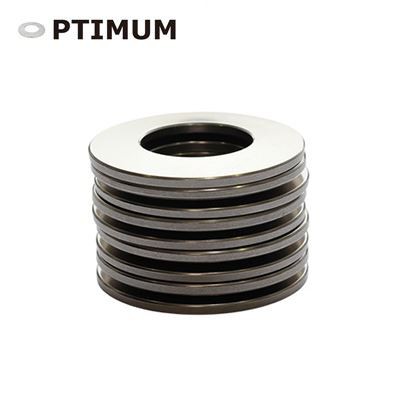
Another sizing hack: stack count. Disc springs can be stacked in series or parallel, right? Series stacking (nesting them, one on top of the other) multiplies the deflection—so if you need more “give” without extra force, stack 2 or 3. Parallel stacking (laying them side by side) boosts the load capacity. But here’s the catch: always use the same spring size and material for stacking. Mixing a 5mm thick spring with a 6mm one? That causes uneven force distribution, which makes one spring carry more load than it’s designed for, leading to early failure. I’ve seen clients do this to save a buck, and they end up ordering 3x more springs than they should in 6 months. Not worth it.
Next up, surface prep and installation—this is where so many guys skip steps and wonder why their springs are dead in a week. The ball bearing part is key here, so the contact surfaces (the flat faces of the disc springs and the bearing balls) need to be clean, no burrs, no rust, no debris. Even a tiny speck of metal shavings between the spring and the ball can create a friction point that wears everything out fast. When we ship our springs, we individually wrap them in anti-rust paper and include a little cloth to wipe down the seating area before installation—use that.
Also, don’t over-torque the fastener holding the spring. I get it, you want it tight so it doesn’t shift, but over-torquing flattens the conical shape of the disc spring. Once that cone is crushed, it loses its spring force permanently. We had a client last quarter who was torquing his bolts with a 1/2-inch breaker bar—no wonder his springs were turning into flat washers in a month. Pro tip: use a torque wrench, and follow the spring’s recommended torque value (we print these on every product spec sheet, and our sales team will send them over if you just ask). If you don’t have a spec, err on the lower side—you can always tighten a little more, but you can’t uncrush a spring.
Then there’s alignment. This is a big one for ball bearing disc springs specifically. If the spring isn’t perfectly aligned with the load, the ball bearings can bind instead of rolling smoothly. Binding means friction, friction means wear, wear means broken parts. How do you check alignment? Simple: when you install the spring, push down on it by hand to make sure it flexes evenly all around. If one side feels stiffer than the other, you’re off-center. If your machine is in a tight space where alignment is tricky, use a centering pin—just a small metal rod that runs through the center of the spring and the fastener hole. It keeps everything lined up until you tighten the bolt, and it’s a cheap fix for a common problem.
Material and heat treatment—let’s talk specs here, because not all disc springs are created equal. Our ball bearing disc springs go through a double-quench and temper process, which makes them way more durable than unprocessed springs. Unprocessed springs have a hardness that can be too low (they flatten easy) or too high (they crack under load). We test every batch on our load test rig—each spring has to hold 150% of its rated load without deforming, and pass 100k cycles at maximum deflection before it leaves our warehouse. If you’re buying springs from a supplier that doesn’t mention heat treatment, run. Those springs will fail, and you’ll be dealing with downtime that costs way more than the extra $0.50 you saved.
Wait, what about lubrication? A lot of people think springs are “dry” parts, but ball bearing disc springs actually need a tiny bit of lubrication to keep the balls rolling smoothly. Too much grease, and it traps dust and dirt, which becomes an abrasive paste—bad. Too little, and the balls wear down fast. Our go-to for our clients is a light, food-grade grease (if their machine is in food processing) or a dry film lubricant like molybdenum disulfide (for heavy industrial use). We add a thin coat of moly to every spring before shipment for free, but if you’re working in a wet environment (like a washdown area), reapply every 3 months. I had a client in the bottling industry who skipped lubrication, and his springs seized up in 2 months—once we added the light grease, they’ve lasted over a year.
Cycle count and maintenance checks—let’s be real, even the best spring won’t last forever. The average life of our standard ball bearing disc springs is 50k to 100k cycles, depending on load. So set a maintenance schedule: every 20k cycles, shut down your machine, pull the springs (it takes 5 minutes), inspect them for tiny cracks, flattening, or discoloration. If you see any of that, swap them out. Don’t wait until the spring breaks and causes a machine jam—those jams can cost you thousands in lost production, way more than replacing a spring early.
Another tip: avoid temperature extremes. Disc springs work best between -40°F and 500°F, give or take. If you’re operating in a furnace room (think metal stamping) or an Arctic cold storage facility, you need a specialized spring—our high-temperature alloy springs go up to 800°F, and our low-temperature ones hold up in -60°F. Using a standard spring in extreme temps is a recipe for metal fatigue, and that’s when springs snap without warning.
Let me wrap this up with a quick story to drive it home. A client of ours who makes farm equipment had been having issues with his hay balers—the springs were wearing out every 3 months. He tried cheap springs from a big online retailer, tried stacking more springs, even adjusted his torque. Nothing worked. We sat down with him, walked through these tips: he was using standard springs in a dusty farm environment, over-torquing the bolts, and not lubricating. We sent him our ball bearing disc springs with moly coating, told him to use a torque wrench, add a little grease every 6 months, and check alignment. Now? Those springs have lasted 18 months, and his downtime’s cut by 90%. That’s the difference between optimizing your spring and just “replacing it when it breaks.”
At the end of the day, optimizing a ball bearing disc spring isn’t rocket science—it’s about picking the right part for the job, installing it correctly, and staying on top of basic maintenance. If you’re still not sure what spring is right for your application, or you need a hand troubleshooting why your current setup isn’t performing, hit us up. We don’t just sell springs—we’ve got engineers who’ve been working with these parts for decades, and we’ll help you get the most out of yours. Don’t let cheap, mismatched, or poorly installed springs slow your operation down. Reach out to our team today to connect and find the perfect solution for your needs.
Conical Spring Washer References:
- Niemann, G., & Winter, H. (2005). Machine Elements: Volume 1, Fundamentals and Mechanics. Springer.
- ASME B18.21.1-2020, Compression and Extension Disc Springs (Belleville Springs). American Society of Mechanical Engineers.
- Shigley, J. E., Mischke, C. R., & Brown, T. H. (2004). Standard Handbook of Machine Design, 3rd Edition. McGraw-Hill.
- SAE International. (2018). Test Methods for Spring Performance and Fatigue Life. SAE International.
Yangzhou Optimum Spring Manufacturing Co., Ltd.
As one of the most professional ball bearing disc spring manufacturers and suppliers in China, we’re featured by quality products and good service. Please rest assured to buy customized ball bearing disc spring made in China here from our factory. For more information, contact us now.
Address: No.9 West of Shuangtang Rd, Yangzhou, P.R. China 225000
E-mail: susie@optimum-spring.com
WebSite: https://www.optimum-spring.com/
